


Park Benches: Cast Iron Outdoor and Garden Benches for Public Spaces
A park bench is one of the few pieces of furniture that has to work for everybody. It stands outside all year, it is used by people who never chose it, and it has to read well from fifty metres away while still feeling right after an hour of sitting. That is why the cast iron bench has changed so little in a hundred and fifty years. Casa Padrino, one of the international specialists for luxury furniture, supplies cast iron and wrought iron benches for parks, hotel gardens, company grounds and town squares, with around sixty outdoor bench models in the English catalogue and delivery worldwide.
This page begins with the object rather than the catalogue: where the public bench comes from, why cast iron won, and what makes a seat comfortable for long sitting. Frames, seats, settings, spacing and anchoring follow.
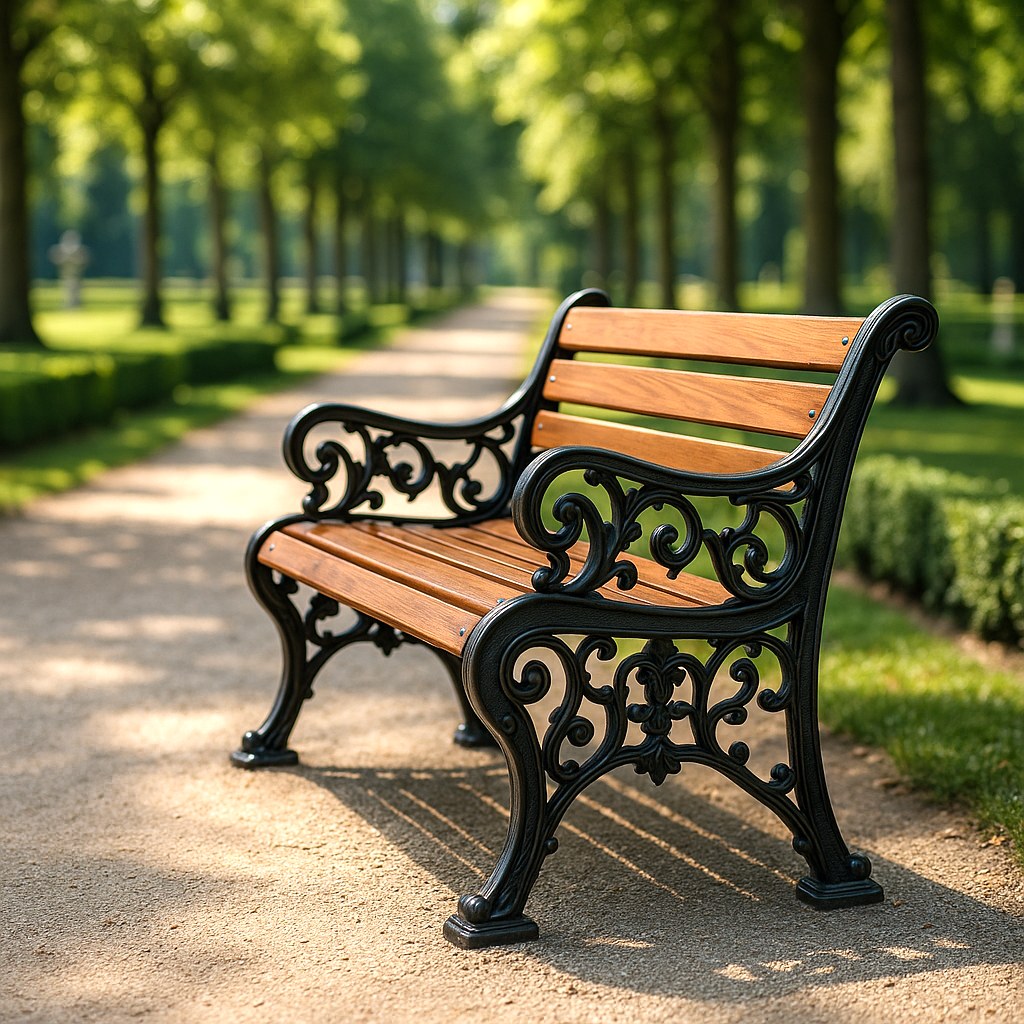
Where the park bench comes from
The public bench is younger than it looks. For most of European history a laid out garden was private property, and the seating in it answered to one owner. What created the bench as a type was the public park of the nineteenth century, above all Victoria Park in the east of London, laid out from 1845, and Birkenhead Park near Liverpool, opened in 1847 as the first park built with public money and free to enter. A park belonging to a whole town needed furniture that could survive a public with no reason to be careful with it.
The material that answered the question was cast iron. The Coalbrookdale ironworks in Shropshire showed cast garden seats at the Great Exhibition of 1851 and sold them from a catalogue for decades afterwards, in patterns of ferns and brambles that foundries across Europe copied. In Paris the engineer Adolphe Alphand, working under Baron Haussmann in the eighteen sixties, treated the whole city as one furnished room, with benches, lamp columns and railings designed as a family.
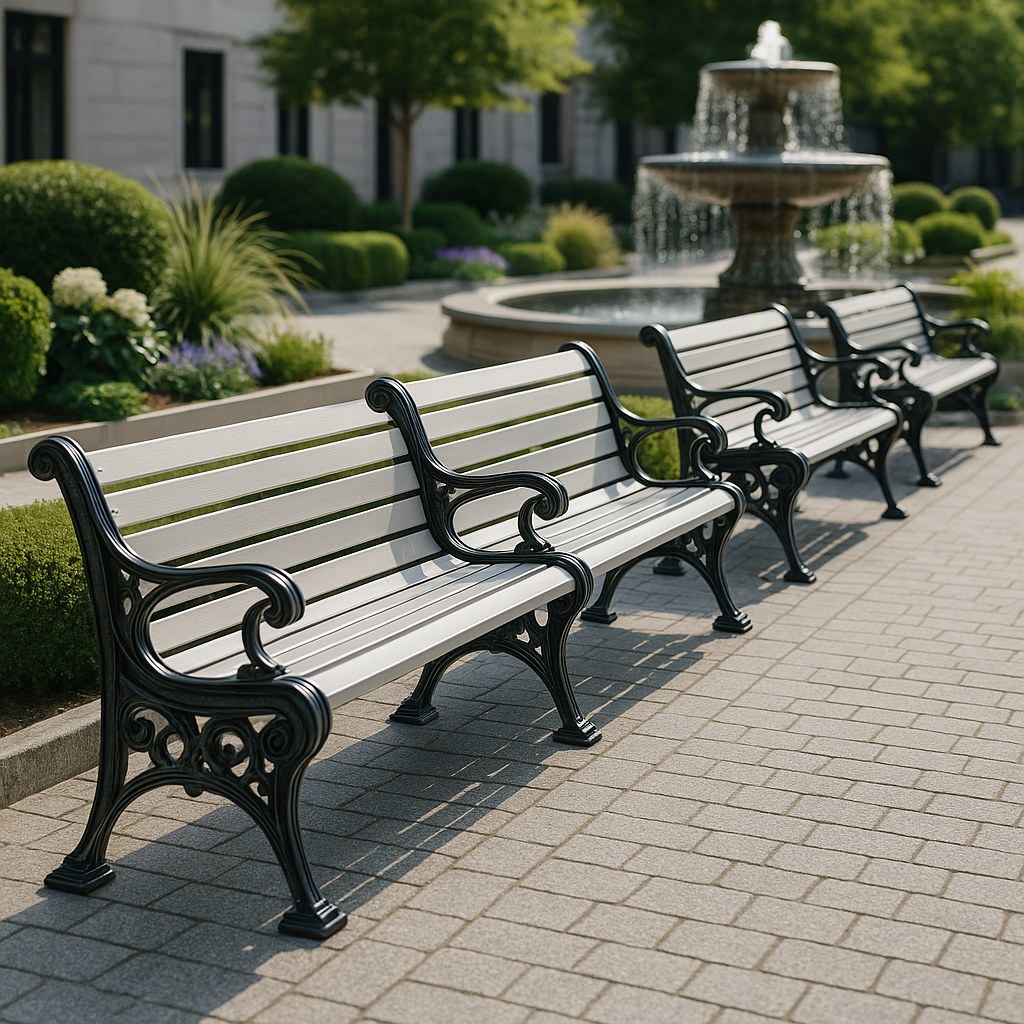
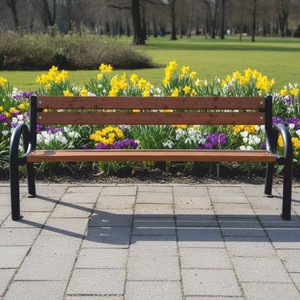
What settled out of this is the shape still built today. Two decorated cast ends carry a set of straight slats bolted between them. The ends outlive several sets of slats, and a slat can be replaced without touching the frame. A form that repairable rarely needs redesigning, which is why a bench cast from a nineteenth century pattern still looks right today.
Cast iron, wrought iron and steel: the frame
Three metals sit behind almost every outdoor bench, and they behave differently enough to be worth telling apart.
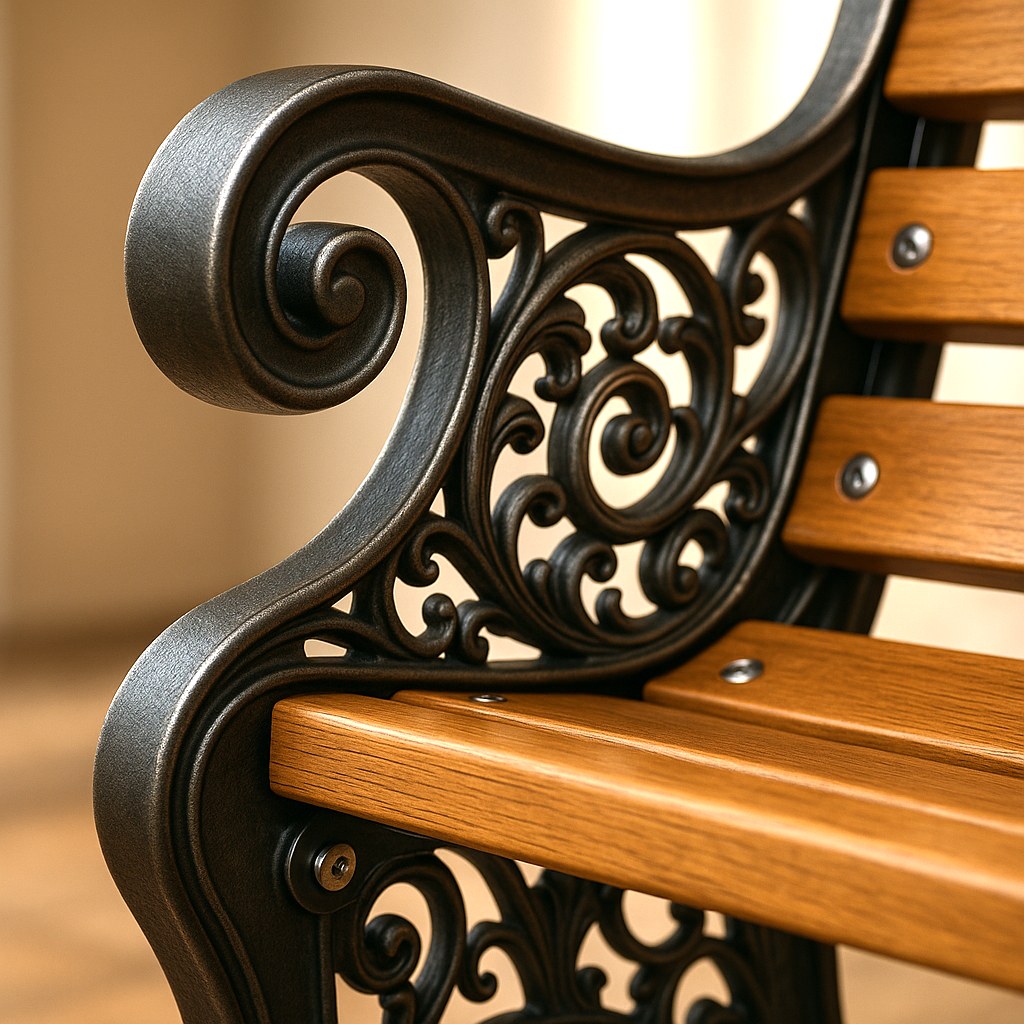
Cast iron is melted and poured into a mould taken from a carved pattern. Because the ornament lives in the mould, a scrolled bench end costs little more to produce than a plain one, which is why Victorian benches are so decorated. Cast iron is hard wearing and very strong in compression, but brittle: it does not bend out of shape, it chips if something heavy strikes an edge. Its weight is a feature, since a bench two people cannot casually carry away stays where it was placed.
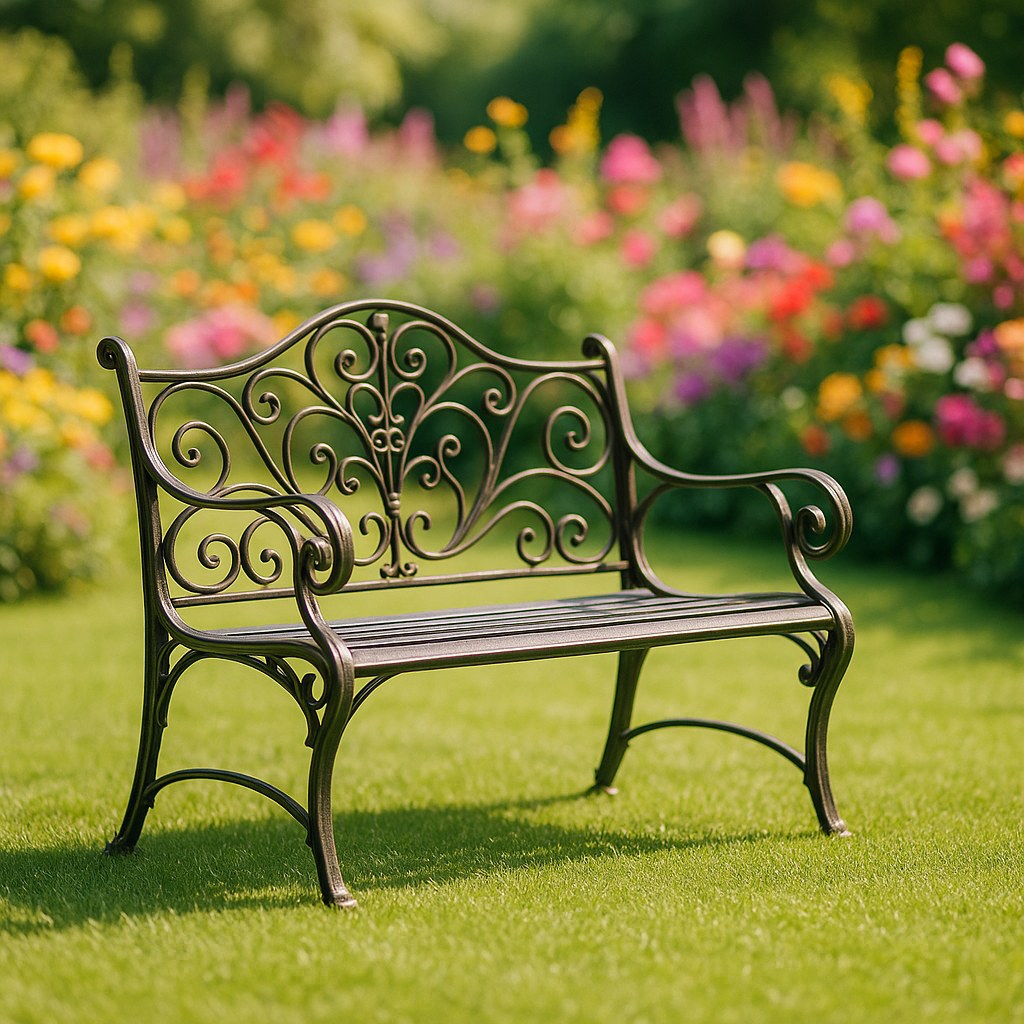
Wrought iron is the opposite discipline. It is worked hot at the forge, drawn out and scrolled by hand, and it is tough and ductile rather than brittle. A wrought iron bench shows its origin in the flowing scrollwork of the arms and back. Most pieces called wrought iron on the market today are hand worked mild steel in the same vocabulary, a fair modern equivalent as long as the coating is sound.
Steel in tube and flat bar, welded and powder coated, gives the slimmest lines and the lightest bench.
Whatever the metal, the coating decides the service life. Expect the first rust at cut edges, at bolt holes and where a foot stands in wet leaf litter, and in coastal or poolside air specify stainless fixings.
Timber slats or metal: the seat
The frame decides how a bench looks. The seat decides how it feels, and there are only two serious answers.
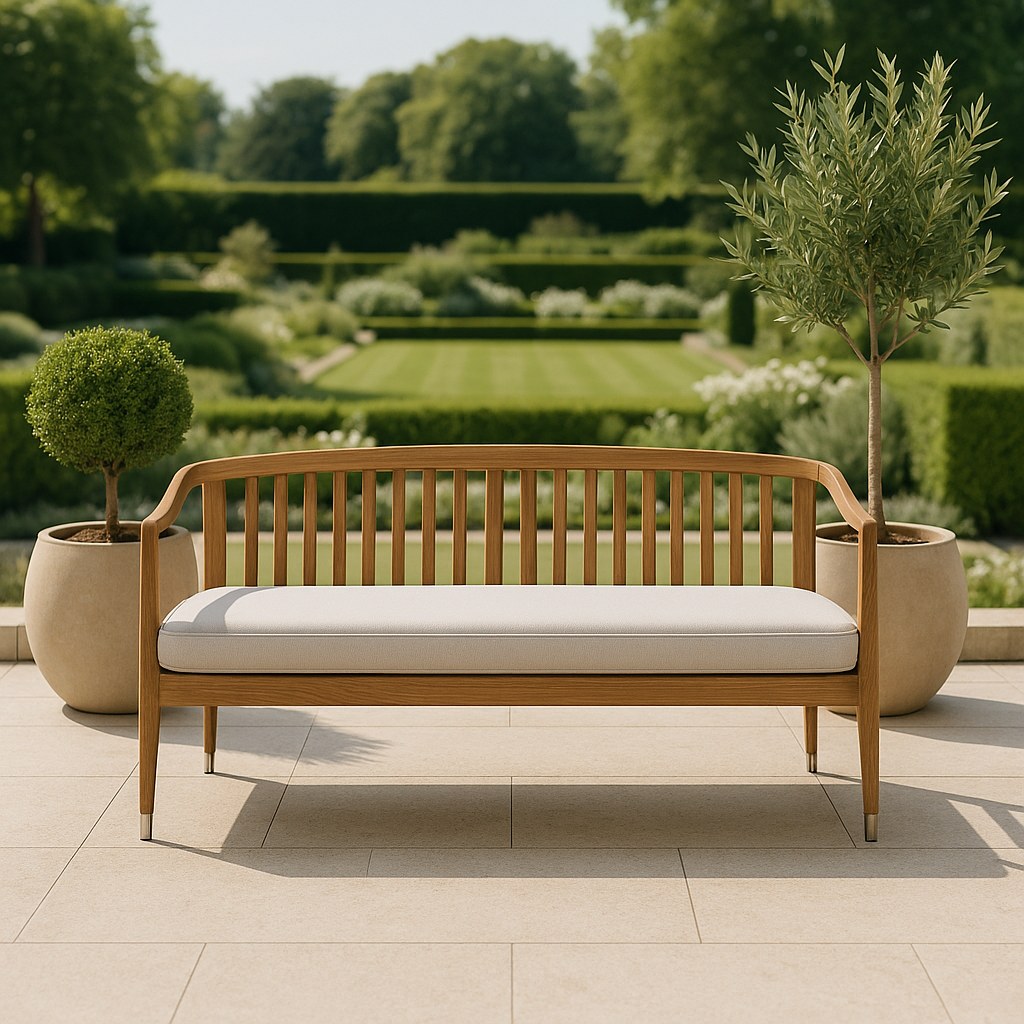
Timber slats are the historic pairing and the more comfortable one. Wood does not draw heat away from the body, so a timber seat is usable on a cold morning and bearable in full sun, where bare metal is neither. Slats are bolted individually, so repair is trivial, and the gaps let rain fall through. A natural finish silvers into a soft grey, which is a finish and not a fault.
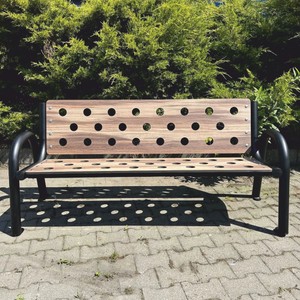
Metal seats, whether perforated sheet or narrow bars, have nothing that can rot, swell or need oiling, and they take neglect better than any timber. The price is thermal: dark metal in summer sun becomes uncomfortable and in frost it is unfriendly, so choose the position with shade in mind.
What makes a bench comfortable for a whole hour
Public seating is designed for a longer sit than most garden furniture, and the geometry is well established. These are the numbers to check.
- Seat height of roughly 43 to 45 cm. Both feet should rest flat on the ground with the thigh supported. Too high leaves shorter users dangling, too low makes standing up hard work.
- Seat depth of roughly 40 to 45 cm. Deep enough to reach the backrest without perching, shallow enough that the front edge does not cut in behind the knee.
- A backrest leaning back by about ten to fifteen degrees from upright, so weight transfers to the back instead of the base of the spine. A slight rearward tilt of the seat stops the sitter sliding forward.
- Support low on the back. A shaped rail at the height of the lower back does more for comfort than a tall backrest meeting only the shoulders.
- Armrests about 20 to 25 cm above the seat. They matter most to older visitors, who use them to lower themselves and to push themselves back up. In a clinic or spa setting, arms are not decoration.
A backless bench can be used from either side, which suits a viewpoint facing two ways, but wherever people are meant to stay, specify a back.
Where a bench of this kind belongs
These benches belong wherever seating has to look composed while taking hard use.
- Parks, public gardens and avenues. The original brief, and the setting where an ornamental cast end still marks a walk as designed.
- Hotel gardens, terraces and grounds. A bench under an old tree gives guests somewhere to sit that is not the terrace, which changes how large a garden feels. It pairs with our hotel furniture and decoration range and with the schemes on our page for luxury hotel furniture.
- Company grounds and business parks. Seating at the entrance and along internal paths makes a site feel considered.
- Spa gardens, clinics and retirement schemes. Here the points above stop being refinements: arms, a real backrest and short distances between benches are the whole specification.
- Town squares and churchyards. Fixed benches in a formal arrangement, anchored and in one repeated model.
- Large private gardens. A garden bench at the far end of a lawn is a destination first, a seat second.
The outdoor programme sits in garden furniture, stoves and decoration, the benches under benches and in park and city furniture, where the longer city bench models with backrests are listed. For an overview of how outdoor seating, tables and accessories work together across a whole garden, see our page on garden furniture for large properties. Where a bench faces a destination, that object usually comes from garden sculptures or from fountains and water columns.
Measurements, spacing and anchoring to the ground
Benches are sent back over dimensions and access far more often than over appearance. All of this can be checked before ordering, with a tape measure and ten minutes on site.
Length and how many people it really seats. Reckon 55 to 60 cm of width per adult. A bench of 150 cm seats two adults in comfort, while 200 cm is the honest three seater and the length normally chosen for public places. Arms take up part of the run, so measure the clear width between them rather than the overall length. A central armrest divides the seat into two defined places.
Depth and the space in front. A bench with a raked back needs about 60 to 70 cm of ground depth. Leave at least 90 cm of clear walking width in front of it, and 120 cm where a wheelchair or a pram has to pass a seated person, so against a wall the bench occupies a strip 1.7 to 1.9 m deep.
Spacing along a route. In an ornamental garden a bench every 25 to 30 m gives a rhythm without cluttering the view. On a route meant for older or less mobile visitors the accepted guidance is much tighter, a resting place every 50 to 100 m, and that should drive the layout of a spa or clinic garden.
The ground. Cast iron feet need a firm, level base. On a lawn they sink unevenly within a season and the bench begins to rock, so set slabs or a small concrete pad under them, and do the same on gravel.
Anchoring, or not. Bench feet are normally cast with fixing holes. In a public or unsupervised place, bolt them into a concrete foundation with expansion or chemical anchors and stainless fixings, which prevents theft and the more common problem of a bench being tipped backwards. Where the surface cannot be drilled, weight alone is a deterrent, not a lock.
Getting it to the spot. A cast iron bench of 200 cm is a two person lift at least, and a four person job over soft ground. Measure the narrowest point of the route from the kerb to the final position: gate width, the turn at the corner of the house, the width of steps. Benches travel flat packed, but the cast ends stay heavy.
Care through the seasons
Timber slats want oil, not lacquer. This is the most useful maintenance advice for an outdoor bench. A lacquer film looks perfect for one season, then cracks where the wood moves, lets water in behind it and holds it there, and the only honest repair is to strip the slat back. An oil finish penetrates instead of sealing and is renewed by brushing on another coat once or twice a year.
Ironwork wants inspection rather than work. Once a year, look at the bolt heads, the cut edges and the underside of the feet, where a coating fails first. A chip treated with primer and paint in spring stays a chip; left for three winters it becomes a rust blister.
Winter. Cast iron is indifferent to frost. The damage comes from water that cannot escape, so keep drainage holes clear and sweep wet leaves from under the feet in autumn. A plastic cover often does more harm than good, since it traps condensation.
Delivery, assembly and worldwide shipping
Casa Padrino ships worldwide. Benches travel by freight forwarder with a delivery appointment arranged in advance, small accessories by parcel service. Delivery is made kerbside to the address given. Carrying the bench through the property, across a lawn, up steps, into a lift or to the point where it will finally stand is not part of the standard service, so please arrange help on site for the day of delivery and check the route in advance. We do not operate a showroom, so advice is given by telephone and email.
Assembly is straightforward: the two ends bolt to the back rail, then the slats. Check the bolts again after the first season, because timber shrinks slightly in its first summer outdoors.
Why Casa Padrino
Casa Padrino has become one of the internationally known names for baroque, Art Nouveau, Art Deco and contemporary luxury furniture, with customers in more than fifty countries and a catalogue running into thousands of pieces. In May 2025 our designer Marvin Schertl received the International Design Award for Excellence in Luxury Furniture, presented at the gala dinner in Cannes.
For outdoor seating, two things follow. Depth of range, because sixty models mean a real choice of length, frame and seat, so that a park, an avenue and an entrance court can be furnished from one family. And the ability to supply the rest of the setting from one house, from outdoor and dining chairs and dining tables for the terrace to the sculpture at the end of the walk. Projects combining indoor and outdoor seating are shown on our page for luxury restaurant furniture. The complete collection is at casa-padrino.de.
Frequently asked questions about park benches
How many people fit on a 150 cm and on a 200 cm bench?
Allow 55 to 60 cm per adult. A 150 cm bench seats two comfortably and a 200 cm bench seats three, which is why 200 cm is the usual public length.
What is the difference between cast iron and wrought iron?
Cast iron is poured into a mould, so the ornament is part of the casting: heavy, hard wearing and brittle. Wrought iron is worked hot and bent by hand, which gives the scrollwork.
What seat height is right for a park bench?
Around 43 to 45 cm, so both feet rest flat on the ground, with a backrest leaning back about ten to fifteen degrees.
Do the benches have to be bolted to the ground?
Not necessarily. In a private garden the weight is usually enough. In a public place, bolt the feet into a concrete foundation with stainless anchors.
Can a bench stand directly on a lawn?
It can, but the feet sink unevenly and it begins to rock within a season. Set slabs or a small concrete pad under them.
How do I look after the timber slats?
Oil them once or twice a year rather than lacquering them. A lacquer film cracks, traps water underneath and has to be stripped; an oil finish is simply recoated.
Can the benches stay outside in winter?
Yes. Cast iron and a sound coating cope with frost. Keep drainage holes clear and sweep leaves from under the feet.
Timber or metal seat, which should I choose?
Timber is more comfortable in both cold and heat and is repaired slat by slat. A metal seat cannot rot, but it becomes hot in full sun and cold in frost.
How much space do I need in front of a bench?
At least 90 cm of clear walking width, and 120 cm where a wheelchair or a pram has to pass someone seated.
How is a bench delivered, and do you ship abroad?
We ship worldwide. Heavy benches travel by freight forwarder with a delivery appointment, smaller items by parcel service. Delivery is kerbside to the address given, so please arrange help on site for the final positioning.
Selected pieces from our collection

You may also be interested in
Back to the overview: Luxury Furniture for Hotels, Villas & Projects Worldwide